
Quick answer: Good jewellery photography is about controlling light, not adding more of it. Large, soft sources give gold and silver clean, flattering highlights; small, harder accents wake up the stones; and black or white cards define the edges of the metal. Most jewellery brands need three kinds of images from every collection: accurate product shots, creative still-life frames and on-model campaign images. It pays to plan all three as one production so they look like one brand. Below is what we’ve learned on our jewellery shoots for Bhima, Akshaya Gold & Diamonds and Tanmayi Jewellery.
Why Jewellery Is So Hard to Photograph
A necklace is a tiny, curved mirror. Polished gold reflects everything around it: the lights, the ceiling, the camera and the person holding it. Diamonds and gemstones are the opposite problem. They only sparkle when light hits them from the right direction, so a lighting set-up that flatters the metal can leave the stones looking flat and grey.
Then there’s scale. The details customers pay for, like filigree, stone setting, engraving and the finish on a clasp, are often a few millimetres across. At that magnification, every speck of dust and every fingerprint shows up. And because jewellery is a high-value, high-trust purchase, colour has to be honest. If the gold looks more orange online than it does in the store, customers notice, and that dents trust.
That’s why jewellery photography rewards patience and planning more than almost any other product category.
The Three Kinds of Jewellery Photography a Brand Needs
1. Product shots (catalogue and e-commerce)
The piece on a clean white, grey or dark background, lit evenly and photographed from consistent angles. These go on product pages, marketplaces and catalogues, so accuracy matters more than mood: true colour, sharp detail from front to back and no distracting reflections. For Glain Lifestyle’s modern silver range, lighting was crafted to avoid harsh glare while keeping crisp detail in the silver textures, and post-production kept tones consistent across the whole asset bank.
2. Creative still life (styled jewellery photography)
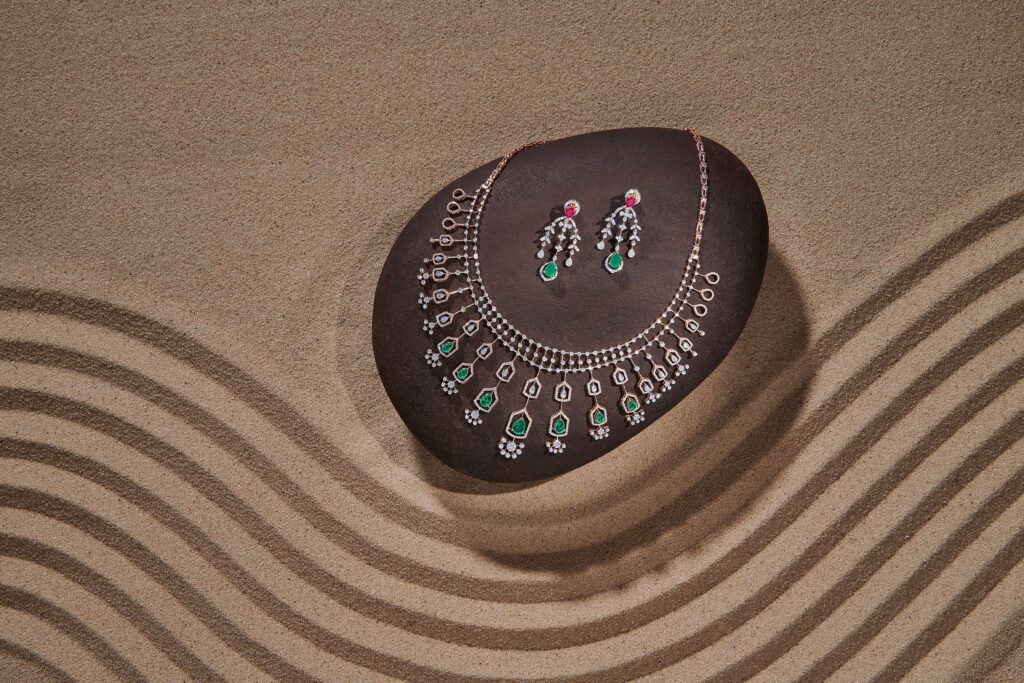
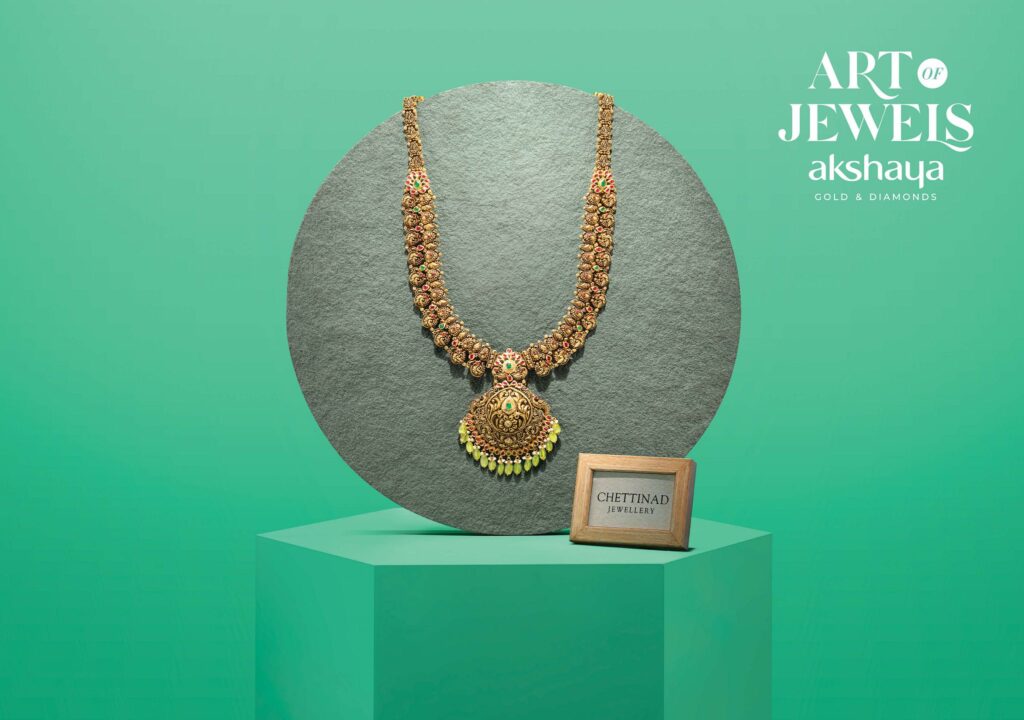
The piece placed inside an idea: a set, a surface, props and a mood that tell the customer what the collection means. For Akshaya’s Art of Jewels campaign, we treated jewellery as timeless artefacts and borrowed the language of a museum: pedestals, controlled light, negative space and depth. For Bhima’s festive 2023 campaign, the still life ranged from diamond sets resting on stone surrounded by sand-art patterns to gold jhumkas lined up on a pastel staircase.
3. On-model campaign images
Jewellery worn by a person, styled with the right clothing, hair and make-up, in a setting that matches the collection. These images answer the question every buyer has: how will this look on me, and where would I wear it? On the Tanmayi Jewellery campaign, the talent wore green sarees against a lush green backdrop, so the gold became the brightest, warmest thing in the frame.
4. Film and motion
Not strictly photography, but increasingly part of the same brief. Akshaya’s campaign carried the museum look into three digital films with slow camera moves, controlled lighting transitions and traditional Indian music. For Bhima’s Kahani collection, the jewellery was woven into a full narrative film; you can read how we built it in our Kahani behind-the-scenes post.
How to Light Jewellery
There’s no single correct set-up, but a few principles hold across almost every jewellery shoot.
- Use big, soft light for metal. Because gold and silver reflect the light source itself, the size and shape of that source becomes the highlight you see on the piece. A large diffused source gives smooth, rich highlights. A small bare light gives hard, distracting hotspots.
- Add small, controlled accents for stones. Diamonds and gemstones need a more directional light to show sparkle. A small accent from the right angle brings the stones alive without flattening the metal.
- Shape with cards, not just lights. Black cards placed close to the piece put dark lines into the reflections, which gives polished gold its shape and depth. White cards bounce soft fill into the shadows.
- Balance shine and glare patiently. On the Kahani film, we spent hours adjusting diffusion layers, experimenting with bounce boards and fine-tuning key-light ratios so the gold kept its shine without glare. Expect this to take time on set.
- Lock colour early. Shoot a colour reference at the start of each set-up and keep white balance consistent, so yellow gold, rose gold and white metals stay true across the whole collection.
- Plan for depth of field. At close range, very little of the piece is sharp in one frame. Photographers often shoot several frames at different focus points and blend them, so the whole necklace is crisp from front to back.
Jewellery Photography Backgrounds and Props
The background is part of the message. A few patterns that work:
- White or light grey for catalogue and marketplace images, where clarity and consistency come first.
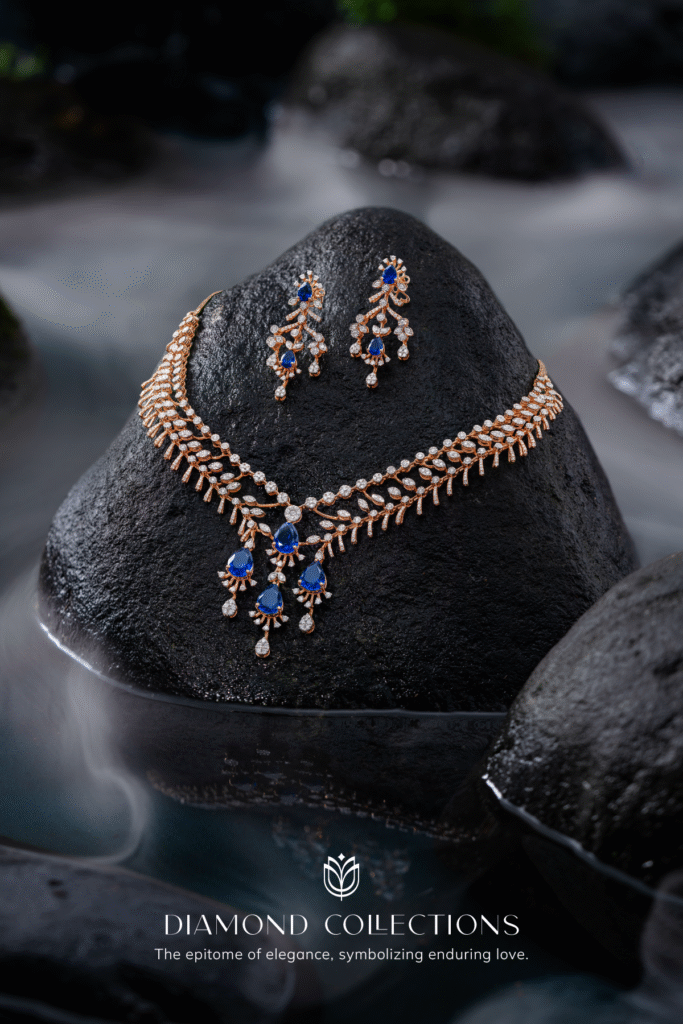
- Dark, matte surfaces such as black stone or slate for diamonds and white metals. Darkness around the piece makes the sparkle read more strongly.
- Natural textures like stone, moss, wood and leaves for traditional gold. They add warmth and suggest craft and heritage without competing for attention.
- Colour blocks and pedestals for contemporary or concept-led campaigns. Akshaya’s green and blue backdrops with display pedestals are a good example.
- Cultural and festive cues such as marigolds, traditional sweets, sarees and brass, for festive and bridal collections. Use them as supporting characters, never the hero.
Props for jewellery photography should be chosen for scale and texture first. Busts and stands show how a necklace falls. Hands show the size of a ring. Fabric shows how a piece sits against skin or silk. If a prop draws the eye before the jewellery does, take it out.
Jewellery Photography Ideas Worth Stealing
- Tell a story with an object. In Kahani, a bride discovers an ornate book of designs that come alive as the real collection.
- Display it like an artefact. Museum-style pedestals and negative space make a piece feel precious and permanent.
- Build a small world. A forest, a stream, a stone garden or sand art can say “nature-inspired” faster than any caption.
- Play with rhythm. Repeating pieces, such as earrings on a staircase, create pattern and a little wit.
- Get close to the craft. Macro frames of settings, engraving and texture tell customers about quality without a word of copy.
- Let the festival set the mood. Onam, wedding season or Valentine’s Day each suggest a palette, props and gestures.
- Use hands and gestures. A necklace being clasped or a ring being held adds emotion and shows scale.

A Note from Naseef: Building a Forest Inside the Studio for Tanmayi
The Tanmayi Jewellery campaign is one I return to often when people ask how we approach jewellery. The idea was to reflect the natural grace of Tanmayi’s Turkish and Diamond Collections. Over two days, we built a nature-inspired set inside our studio in Kochi, with fresh plants, moss, vines and even a handcrafted waterfall.
The two collections needed two different worlds. For the Turkish Collection, we styled the gold among wooden textures and soft greens, so the warmth of the metal sat comfortably against nature. For the Diamond Collection, we drew on water and light instead: smooth black stones, misty textures and gentle reflections, so the diamonds felt like water droplets frozen in time.
Most of those two days went into very small things: fine-tuning tiny reflections, adjusting how dense the mist was and shaping the light until each piece became the natural focal point. My biggest lesson from jewellery is this. You don’t light the set and then drop the jewellery in. You build the light around the metal and the stones first, and let the set support them. The final images went on to be used across billboards, in-store displays and print for Tanmayi’s new season.
I’ve written about the full shoot in the making of the Tanmayi Jewellery campaign, and you can see more of my campaign work on my advertising photography page.
How to Plan a Jewellery Shoot
- Make a piece list. Include SKU codes, metal, stones, collection and the channel each image is for: website, marketplace, ads, print or store displays.
- Agree on handling and security. Decide who brings the pieces, who handles them on set and how they’re checked in and out each day.
- Clean everything before it reaches the set. Gloves, lint-free cloths and a blower save hours of retouching.
- Brief styling as a team. On our campaigns, costume stylists and hair and make-up artists are part of the crew, because the saree, the neckline and the hairstyle decide how a piece is seen.
- Plan formats up front. Bhima’s Kahani film was delivered in vertical versions for Instagram Reels and YouTube Shorts and horizontal versions for YouTube, in-store screens and campaign placements, with stills and cutdowns alongside. Frame for both on set.
- Set retouching rules. Agree on what gets cleaned (dust, scratches, reflections) and what must never change (stone colour, proportions, metal tone).
What Drives the Cost of a Jewellery Shoot
Jewellery photography pricing depends far more on complexity than on image count. The main factors are the number of pieces and angles, the type of images (catalogue shots are fastest, concept sets and on-model campaigns take longest), set building and props, talent, styling and make-up, film or motion in the same schedule, and the depth of retouching. High-polish metals and stones need more lighting and retouching time than most products, so expect a jewellery shoot to cost more per image than a typical e-commerce shoot. The best way to compare quotes is to share the same piece list and channel plan with every studio.
Frequently Asked Questions
What is jewellery photography?
Jewellery photography is the craft of photographing rings, necklaces, earrings, bangles and other pieces for catalogues, e-commerce, advertising and social media. It ranges from clean product shots on white to styled still life and on-model campaign images.
What is the best background for jewellery photography?
For product pages and marketplaces, white or light grey works best because it’s clean and consistent. For campaigns, dark matte surfaces suit diamonds and white metals, while natural textures like stone, wood and leaves suit traditional gold.
How do you photograph jewellery without reflections?
You can’t remove reflections completely, and you shouldn’t, because reflections are what make metal look like metal. The goal is to control them. Use large diffused light, place black and white cards to shape what the piece reflects, keep the camera and crew out of the reflection, and clean up the rest in retouching.
What props are used for jewellery photography?
Common props include busts and stands, stones, wooden blocks, fabric, flowers, mirrors and cultural objects that suit the collection. Choose props for scale and texture, and keep them quieter than the jewellery.
Should jewellery be photographed on a model?
Yes, for at least part of the collection. On-model images show scale, how a piece sits and where it might be worn, which helps customers decide. Pair them with clean product shots so buyers can also see every detail.
Planning a Jewellery Campaign?
At The Vertical Story, jewellery is one of the categories we know best, from product photography to campaign stills and narrative films. If you’re launching a collection or refreshing your catalogue, tell us about your pieces and where the images need to work, and we’ll suggest a shoot plan that fits your channels and budget.
Written by: Naseef Gafoor, Director, The Vertical Story
Produced by: The Vertical Story, Creative Content Studio, Kochi